
Does the ‘geriatric’ pregnancy just need more attention to nutrition?
I found this delicious study Diet, Advanced Maternal Age, and Neonatal Outcomes: Results from the GESTAGE Study (Puche-Juarez, et al., 2025) comparing the nutrient intake between mothers of advanced maternal age (>35) and a control group of younger mothers in Spain.
We do a deep dive into the research on advanced maternal age in our Becoming a Traditional Birth Companion course. The supposed risks to older mothers and their babies are not as clear-cut as the medical industry would have us believe. Older mothers may be more likely to have declining fertility, increased miscarriage, higher rates of diabetes, or hypertension, which may be the result of lifestyle and nutrition.
It’s generally accepted by the SOGC (Society of Obstetricians and Gynaecologists Canada) that the rate of stillbirth at 40 weeks rises from 1/1000 in women under 35 to 2/1000 in women age 40+. Based on that, they recommend early induction for all women aged 40+ which also translates to a nearly 50% c-section rate as a result - with no proof that the induction saves any more babies.
In fact, in some studies, when chromosomal abnormalities were excluded from the data, advanced maternal age wasn’t a risk factor for stillbirth (Stillbirth Collaborative Research Network Writing Group, 2011), (Goisis, et al., 2017).
In this Spanish study, both the older mothers and the control group followed similar eating patterns common to their Mediterranean location. Neither of the 2 groups ate enough to meet the recommended caloric intake for pregnancy beyond the first trimester. This seems to be a global issue (Khammarnia, et al., 2024) that may be influenced by food security and local traditions but is more likely the result of messaging from the medical maternity industry that discourages ‘eating for two’, engages in strict weight monitoring, and lectures about the negative consequences of excessive weight gain (Aparicio, et al., 2020). Pregnant women are simply not eating enough to meet all their nutritional requirements.
In general, older people can have more difficulty digesting and utilising nutrients from food. This can be the consequence of more years of injections, more medication usage, more exposure to antibiotics, pesticides, or hormonal birth control which all impact the gut and our microbiota. Meaning, the older we get, the more we probably need to pay attention to what kind of toxicants we’re exposed to and how we’re getting all our needed nutrients.
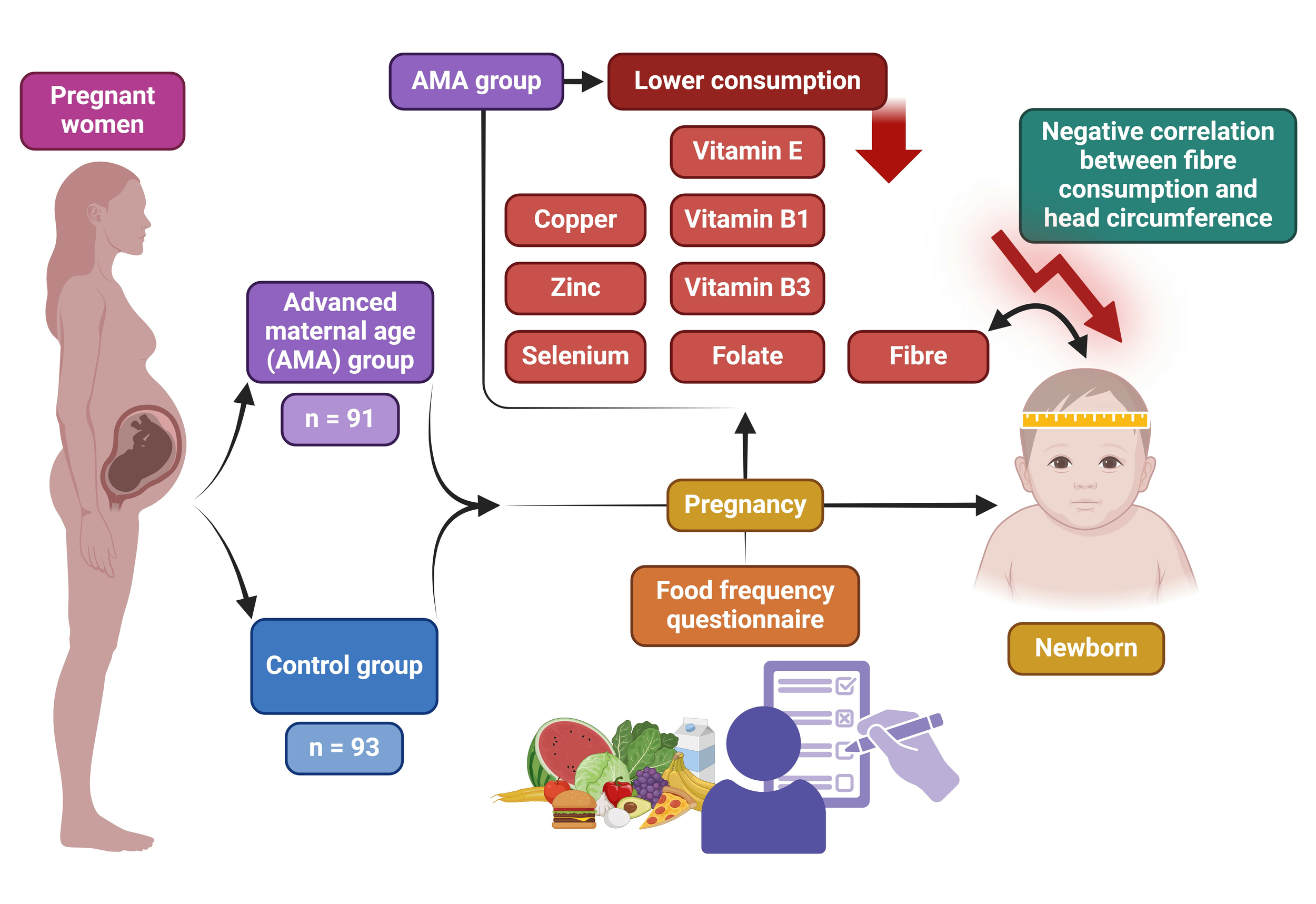
That said, it was the older mothers whose diets were significantly lacking in copper, zinc, selenium, vitamins E, B1, B3, folate, and fibre compared to the control group. The lack of fibre was associated with larger foetal heads, indicating a possible connection to unregulated blood glucose.
This infograph comes from the study (Puche-Juarez, et al., 2025).
The maternity services industry tends to treat “geriatric” pregnancies as a ticking time bomb waiting until they can induce and rescue the baby from her dusty old uterus. What if the answer to some of those increased complexities seen in older women is related to lack of good nutrition?
It’s time to restore common birth wisdom back to common families, beginning with learning how to really eat when you’re pregnant.