
How long should a child’s immune function suffer from unnecessary interventions?
I’ve been sitting on this study for some time as I find it triggers deep levels of disgust at what is being perpetrated on women and babies – on humanity, really. Intrapartum interventions and outcomes for women and children following induction of labour at term in uncomplicated pregnancies: a 16-year population-based linked data study (Dahlen et al., 2021) compared outcomes between healthy women whose labour began normally (spontaneously) and those who were induced for no medical reason. The study looked at how the mother fared in the immediate term and how the baby fared up to 16 years old.
While we know that induction of labour comes with more problems for the mother and baby, the premise behind induction is that it’s an intervention where the benefits outweigh the risks. The primary adverse outcome that induction is supposed to prevent is stillbirth. Given that the rate of inductions has skyrocketed with no corresponding improvement in stillbirth, one has to question this premise.
In looking at this study, my first question is why are so many healthy women being induced for no medical reason? Including women whose pregnancies were only 37 weeks. A medical reason for induction means the mother or baby are becoming compromised and ending the pregnancy may prevent things from becoming worse, such as hypertensive disease, foetal distress, or chorioamnionitis. But inducing just because a woman is pregnant is becoming increasingly common without any consideration for long-term consequences.
Of course, the knee jerk reaction is to blame mothers for requesting this. We live in a society that makes it difficult to be full-term pregnant. The supposed “due date” puts tremendous pressure on her to produce the child in a timely manner. The incessant fear mongering about childbirth makes most of us want to just get it over with. Financial pressures keep pregnant, uncomfortable women in the workplace longer than her resources tolerate. And poor or under-nutrition (I discussed this in a previous rant) means her resources run out sooner.
That said, this issue lies directly at the feet of the technocratic birth services industry and their modus operandi of non-evidenced based rituals and routines. They are self-regulating and get away with this nonsense.
This particular study looked at the medical records of 474,652 births from New South Wales, Australia (2001–2016). Australia’s maternity system is much like any Western nation that relies on Rockefeller education and medical training. These outcomes, while specific to this population, can easily be extracted to encompass most maternity systems.
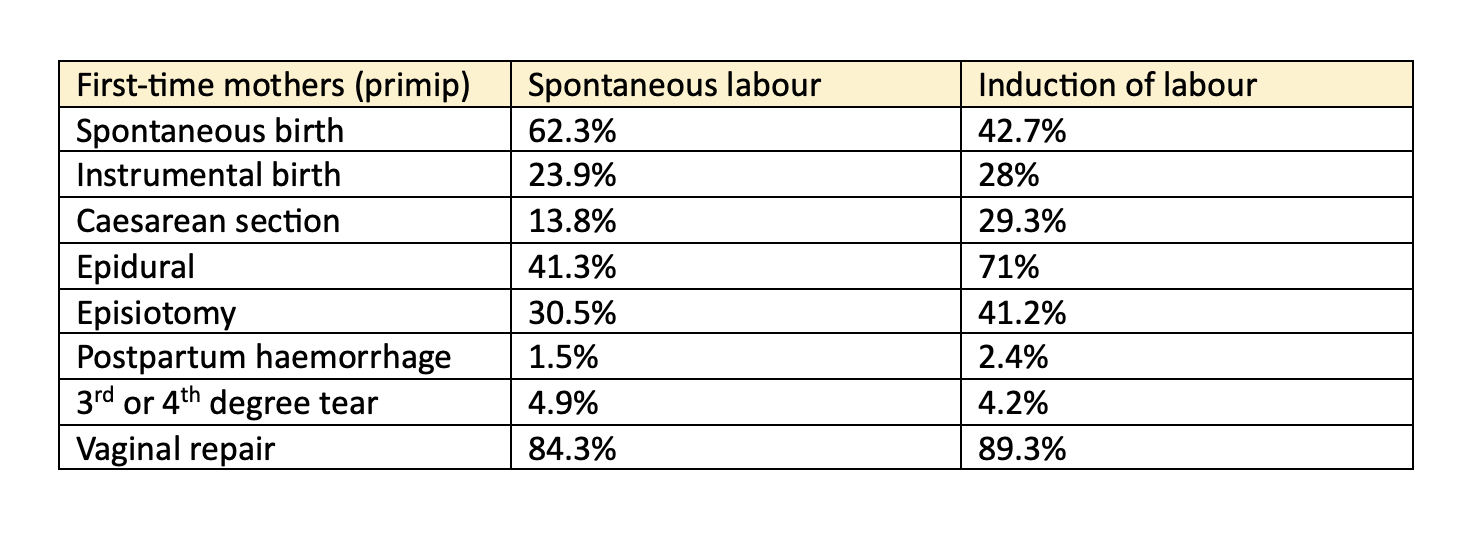
As usual, it’s the first-time mothers who take the biggest hit when it comes to induction. Depending on location, that first c-section may ruin her potential to ever give birth normally again. She may be funnelled into repeat surgery for subsequent children due to the industry’s distaste for VBAC and preference for surgery. While surgery may be needed or preferred, it does come with increased adverse outcomes.
You’ll see in the charts below that induction of labour leads to more surgery, including episiotomies, greater need for epidurals, more use of forceps or ventouse/vacuum, and more vaginal repairs.
Curiously, there are fewer 3rd and 4th degree tears with induction. Hm. What are these practitioners doing during an induction that lessens that adverse outcome? Also, what are these practitioners doing that has them cutting into so many perineums? Why are so many vaginas getting sutured? Where are the normal birth skills that profoundly lessens damage to the perineum? (Hint: those skills reside outside the system)
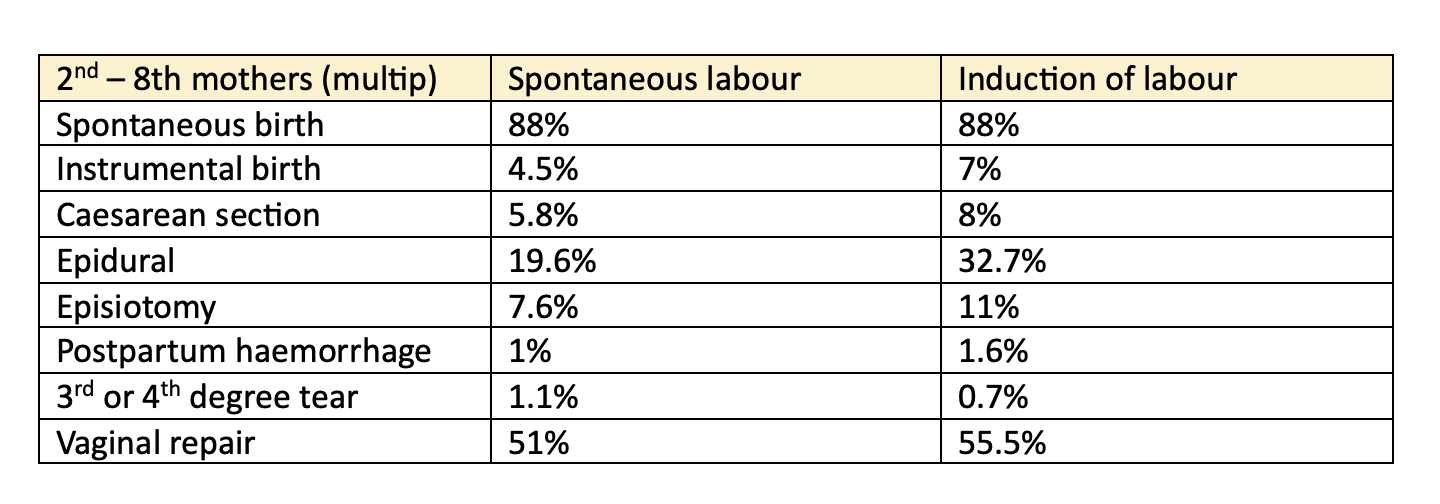
Just as with other studies, the babies who arrived via induction had more difficulty breathing at birth. Having attended a lot of spontaneous labours over the past few decades, for the life of me I can’t fathom how 1 in 4 babies born via spontaneous labour needed resuscitation! What are these people doing to warrant this?

When looking at how these babies fared over the first 16 years of their lives, the study accessed hospital admission records. They didn’t have access to visits to the family doctor over the child’s life, so these are some pretty serious illnesses that required hospitalisation. The ‘infections’ category included serious illnesses such as bacterial sepsis from streptococcus. It seems that forcing a baby out before they are ready impacts their lifetime immune function.
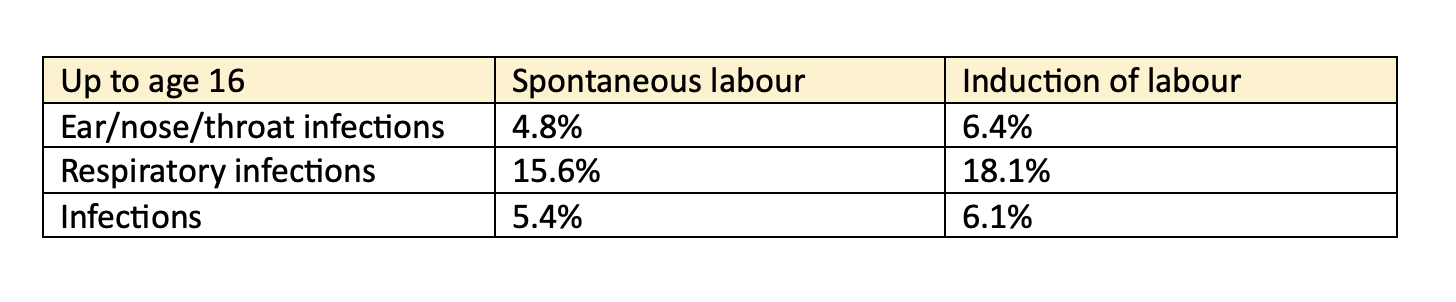
With inductions continuing to rise globally with no commensurate improvement in stillbirth, what we have is an industry out of control that is harming women and babies just because they can. It’s up to us. We can do better ourselves.
Source: