
This research rant comes under the category of “Do bears poop in the woods?”
Pharmaceutical industry information and promotional strategies aimed at prescribers (Mintzes et al., 2026), published on October 9 by the Cochrane Collaborative, looked at 93 studies to determine whether targeted interactions between pharmaceutical representatives and health care practitioners impacted prescribing patterns.
Again, do bears poop in the woods?
TL;DR: yes.
Their conclusions were,
“Overall, we found that promotional interactions clinicians have with pharmaceutical companies are probably associated with harmful outcomes:
~ less appropriate prescribing
~ greater quantity of medicines prescribed or provided
~ higher prescribing costs
~ a greater likelihood of recommending hospital formulary additions of the company’s drugs.
Conversely, in most analyses of organisational conflict‐of‐interest policies restricting the pharmaceutical industry’s promotional interactions with clinicians, restrictions are associated with beneficial outcomes on prescribing appropriateness, quantity, and costs. These findings have implications for cost and quality of care.”
Their analysis looked at 4 types of interactions
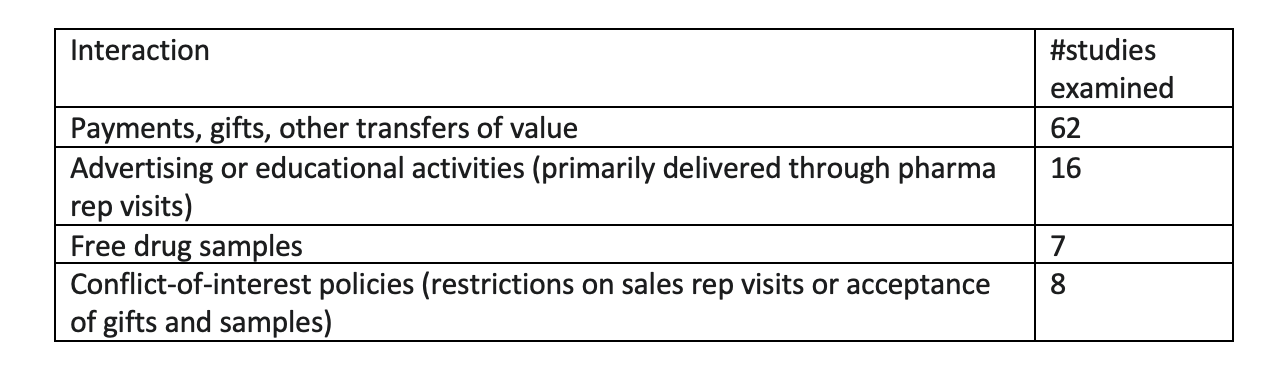
The goal of any company with a product is to get it in the hands of a paying customer. This is accomplished through any number of marketing strategies. No shade there! I have a few courses I market. I absolutely want my efforts to be rewarded with people who enrol. Likewise, the pharma industry needs to get their product in the hands of buying customers. That’s why they exist.
Aside from the US and New Zealand, countries have banned direct-to-consumer marketing. Meaning potential customers must get their information from the prescribing practitioner or through non-direct means such as sports event sponsoring, conventions, etc. In the US and New Zealand, pharmaceutical companies can directly advertise their products so that potential customers get their information directly from the drug makers. Watch any US-based programming and you’ll be inundated with drug suggestions for various ailments.
Where direct-to-consumer marketing isn’t allowed, pharmaceutical companies will target their marketing to the prescribing practitioner.
Of course, we know advertising works. Otherwise, pharmaceutical companies would not have spent about $39 BILLION US dollars in 2025in advertising.
Pharmaceutical products are different from an online course, air duct cleaning, or organic compost for the garden. They are intended to treat medical conditions, generally require medical supervision, and come with a host of consequences – some beneficial and many lethal, where adverse drug events are considered the 3rd leading cause of death in the US alone.
As a leading cause of mortality, these products require caution. That’s why trained practitioners are tasked with being the gatekeeper between the drug and the consumer. Note, some countries do not require a prescribing practitioner and customers can freely purchase these products as they desire – and still don’t have an excess of mortality over countries with a prescribing gatekeeper, eg. Mexico. Apparently, people are generally capable of choosing wisely for themselves when the culture itself promotes self-responsibility and perhaps traditional healing measures.
Anytime you are urged to “Ask your doctor”, you can be assured that your doctor has already received industry marketing to help them in their prescribing choices. This marketing works despite the well-known “illusion of invulnerability” where physicians believe that marketing affects their peers’ prescribing practices but not their own.
Most of us love the idea that we’re simply too smart to be impacted by the all-pervasive mind control of modern living. We may have scoffed at the ad nauseam “safe and effective”. We may have side-stepped the lure of “ask your doctor if this is right for you”.
But truth be told, we’re just as likely to be influenced as the next person. The key is whether that influence leads to love, joy, peace, patience, kindness, goodness, faithfulness, gentleness, and self-control or whether it contributes to your own or others’ suffering, immorality, confusion, and chaos.
Perhaps the message in the end is that we are probably not smart enough to be immune to outside influences, but we are smart enough to choose them wisely.
Make wise choices my friends.